Skip to content
River Song warns you of spoilers.

The Death of Baldr

This entry is part 3 of 9 in the series The Songweaver's Vow: Easter Eggs & Background

Spoiler alert: Baldr dies.

River Song warns you of spoilers.

Okay, seriously, there be spoilers ahead. Mythology nerds likely already know some of what goes down in The Songweaver’s Vow, but if you haven’t read it yet, I suggest you grab a copy and then come back for the background material. (Though to be perfectly fair, even knowing the base myth won’t give you a complete picture, so as long as you’re fully apprised of the spoiler-ific nature of this post….) 

The Death of Baldr
By Mårten Eskil Winge - 3gGd_ynWqGjGfQ at Google Cultural Institute maximum zoom level, Public Domain, https://commons.wikimedia.org/w/index.php?curid=22007120

Norse Mythology: What We Know

This entry is part 2 of 9 in the series The Songweaver's Vow: Easter Eggs & Background

So to start, we don’t know very much about Norse mythology.

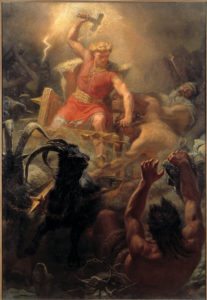
By Mårten Eskil Winge - 3gGd_ynWqGjGfQ at Google Cultural Institute maximum zoom level, Public Domain, https://commons.wikimedia.org/w/index.php?curid=22007120
Thor’s Fight With The Giants by Mårten Eskil Winge

Oh, sure, we have quite a lot of stories, and we’ve made them into quite a lot more stories. But we don’t really have a grasp of how old proto-Germanic religion functioned, how seriously people took these stories, and how these stories fit together.

The Songweaver’s Vow was a tough book to write, for a number of reasons. For one, this was the first time I was writing a story which wasn’t entirely mine and I had to follow a previously-defined plot, as the base story of The Songweaver’s Vow is a Greek legend. And Euthalia brought her Greek stories with her to Asgard, so this meant that I had two separate mythologies to blend while simultaneously trying to make the determined plot my own. It was like writing historical fiction which had to fit both our history and an alternate Earth history. Not gonna lie, it was a workout.

Norse Mythology: What We Know
"Yeah, base, we've got Xena, Jackie Chan, and Robin Hood."

Background: Loki & the Gods’ Gifts

This entry is part 6 of 9 in the series The Songweaver's Vow: Easter Eggs & Background

When you’re working with two full mythologies, there are a lot of tidbits to include that just don’t get the screen time for full explanations. There are a lot of these “Easter eggs” hidden in The Songweaver’s Vow, and I’ll have a whole pile of them to share — in March. (Yes, in March, because some of them would be spoilerific, and we don’t need to revisit exactly how I feel about spoilers, do we, hmmm?)

But here’s a snack to hold you over.Background: Loki & the Gods’ Gifts

enormous bull head (missing ears and horns) from Persepolis, with Laura, photographed at the Oriental Institute of the University of Chicago

The Mysterious Magi: Who Were They?

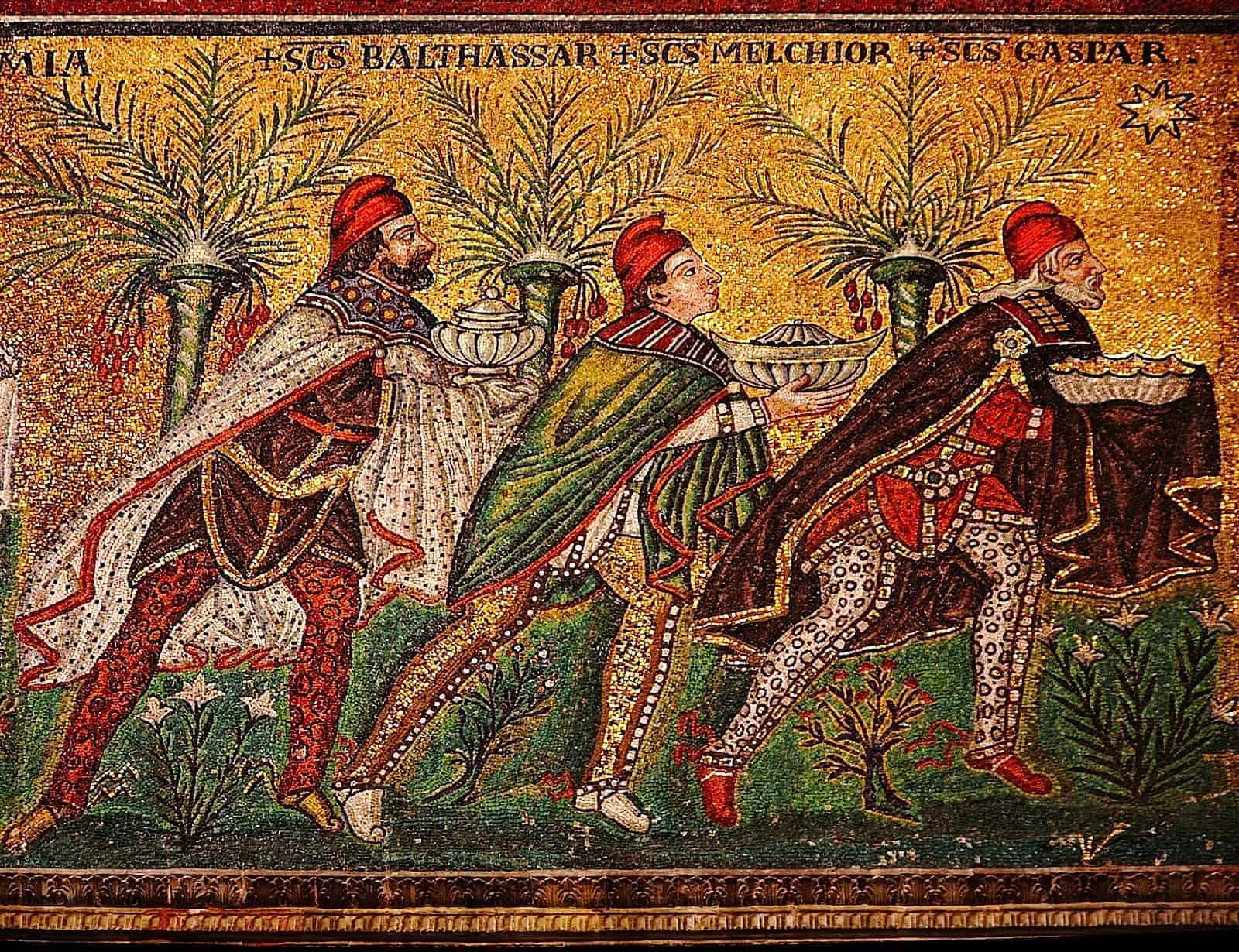
Roman mosaic in Ravenna, showing Magi in Parthian dress
6th century Roman mosaic in Ravenna, showing Magi in Parthian dress

Today’s post is a lot of historical background, much of it research for my book So To Honor Him, put together to explain a story you’ve probably heard. If you’re into history and mystery-solving, come along with me. (Stay close; we’re going to go through a lot of material.)

We’re going to talk about the Magi, or the Wise Men, spoken of in the Biblical book of Matthew.

First off, despite your annual inundation of Christmas cards and nativity scenes, let’s admit that most of what the common man on the street will remember in reference to the Magi is sketchy at best and is not found anywhere in the Bible.

The Mysterious Magi: Who Were They?
The Songweaver's Vow

Vikings everywhere: Leif Erikson Day

Christian Krohg's painting of Leiv Eiriksson d...
Christian Krohg’s painting of Leiv Eiriksson discovering America, 1893 (Photo credit: Wikipedia)

By the time you read this, Leif Erikson Day will be over — autumn Sundays are bad with football and election debates and such — but that doesn’t mean we can’t talk about it.

Leifr Eiríksson founded a Norse settlement at Vinland in Newfoundland. He was the son of Erik the Red, who founded the first Norse settlement in Greenland, and the grandson of Thorvaldr Ásvaldsson, who discovered Iceland. Exploration and settlement was a family business, it seems, and reunions must have been a heckuva scheduling challenge.

Vikings everywhere: Leif Erikson Day
The Songweaver's Vow

Flora & Fauna in Fantasia

This entry is part 7 of 9 in the series The Songweaver's Vow: Easter Eggs & Background

Protected example of Common Ash (Fraxinus exce...
Common Ash (Fraxinus excelsior) (Photo credit: Wikipedia)

Just because a book is a fantasy does not mean it does not require research (and in fact often requires more). Right now I am writing about the plants and animals of Asgard, and I am working to make them as probable as possible.

How do we know what animals lived and what plants grew in a land that never was? We look at where the storytellers lived. The Danes who first told these stories likely based their creatures and plants on the more familiar specimens they knew.Flora & Fauna in Fantasia

Writers Learn EVERYTHING.

I know I’ve talked about the fun and eclectic nature of story research before, but it’s worth returning to. Topics I have researched for this single short story include but are not limited to: the Devils Hole Pupfish the history of Chinese bronze casting the natural history of Kazahkstan cassowary attacks the destructive “Cultural… Writers Learn EVERYTHING.

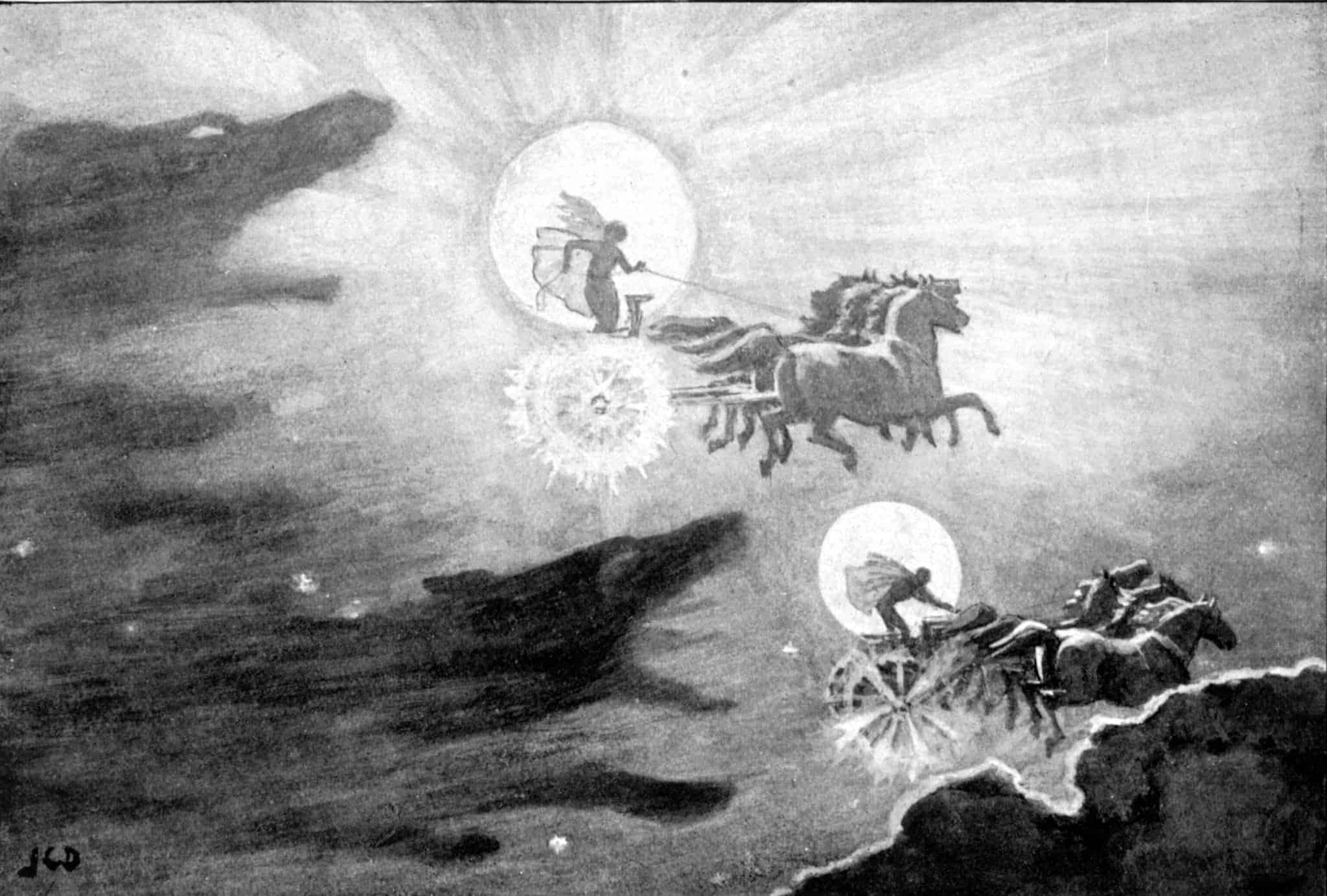
The Wolves Pursuing Sol and Mani (Photo credit: Wikipedia)

Loki Laufeyson, a Piece of Work (in Progress)

The Wolves Pursuing Sol and Mani (Photo credit: Wikipedia)

Today’s #WIPjoy, Day 9, is a fun one: “Share a line that shows off your antagonist.”

In the spirit of sharing, I’m going to give you not a line, but a whole paragraph.

Here’s the thing: any time you find yourself in Norse mythology, even if you’re just visiting, you’re going to have Loki as an antagonist. That’s the nature of Loki. Even if he’s not the primary antagonist, he’s going to be an antagonist, because Loki.  In modern interpretations Loki is often something of an anti-hero, but that’s not consistent with the source material, in which Loki is pretty much just a turd to everyone. (A useful turd, sometimes, but still a turd. And if he does get threatened or beaten fairly often, well, he usually had it coming.)Loki Laufeyson, a Piece of Work (in Progress)

And then I sank Atlantis.

View of the Strait of Gibraltar opening into t...
View of the Strait of Gibraltar opening into the Mediterranean Sea, looking southeast from Gibraltar. (Photo credit: Wikipedia)

I’ve solved the mystery of Atlantis. (Well, okay, I have some plausible ideas.)

That’s the awesome thing about story research — you never know where it’s going to lead you.

I was writing a short story about Atlantis, and speculating a semi-plausible way for it to go as quickly as Plato related, and I started playing around with fissure rifts and earthquakes. Some Googling brought me to an account of how a rift in the African desert opened far more rapidly than previous theory had allowed and will eventually become a new ocean:

And then I sank Atlantis.
debris of the New London School explosion

The New London Texas School Explosion

The top of the London School cenotaph by sculptor Matchett Herring Coe (Photo credit: Wikipedia)

It was a nearly-inconceivable tragedy.

The New London School explosion has gotten relatively little coverage over the decades, in part because the traumatized community did not want to be put on display — and this was before exploitative news camps hounding victims to supply 24-7 coverage, so they were better able to refuse. Rather, it’s reported that rescue organizers told journalists helpers were needed more than news reports and recruited their aid. But it’s one of the most significant disasters you’ve never heard of.

The New London Texas School Explosion